Saturday, November 19, 2011

A Practicing Game


Some of you may know, but most of you don't, but I'm having a BABY!  What does that mean?  It means that I've been sick for a month now and not feeling up to doing much of anything....including practicing.  I'm sure my daughter doesn't mind, but in the back of my mind, I feel like a hypocrite for having a blog all about practicing when I'm not practicing what I preach...at least not lately.  I WILL get back into the routine again sometime soon.

I've spent some time adding practicing charts to the website I've had stored on my computer for months.  So, if you go to The Practice Shoppe website and browse around you may find some new, helpful charts.  Here is a game I found that I used a while back with my little one.  It's a basic chart, so you could make up your own rules.

One way: fill in the boxes with songs that need to be practiced and just start from the beginning and use some sort of marker (these fun erasers work wonders) and proceed one box at a time until you get to the end.  I let my daughter choose what to play on the butterflies.

Another way: fill in the boxes with songs that need to be practiced and make some cards with ways to move across the board (move forward two spaces, move back 3 spaces.)  Include other fun cards (give a kiss to mom, play the next song outside, etc.)

Like I said - simple....we moms don't have time for anything too elaborate.  But perhaps this will put some spice into your practice this week.  I think I may use it again.

Find this chart HERE!

Saturday, October 1, 2011

Are you listening?

This post was contributed by the lovely Tabitha Ricks!


This month's post is on the three types of listening. Edward Kreitman says there are three types of listening: passive, parallel, and active listening.

Passive Listening
This is the type of listening done in the car or at home...or anywhere where it's not the primary activity going on.

This is the way the student learns melodies, quality of tone, and intonation.

Another good idea for this type of listening comes from Michele Horner. She calls it "listening like a maniac." Each day, you listen to the song you're on at least 10 times in a row, then switch to the next song 10 times in a row, and finally the song after that 10 times in a row. Michele Horner did this with her own daughter and was able to learn faster. I have been doing this with Seth, and it has been much easier to for him to learn the next song. One thing to mention is that it's important to listen to the rest of the CD and the other CD's also.


Parallel Listening
This type of listening is listening to the higher books while you are in a lower book. For example, listen to book 4 while you're in book 1. You should listen to all books as early as possible.

This listening builds great vision for the parent and the student (and they will know the pieces much better). It is also good to hear other classical music as much as possible.


Active/Targeted Listening
This is where you have the student listen specifically to one part of the music during practicing and hear specific detail to learn from listening.

This has been helpful to us for a couple of reasons. It has helped Seth learn the song easier, it gives him a break of playing during practicing, and it is training his mind to listen to the details of the piece. When he was learning Humoresque, I had him listen specifically to the order of the piece with the music in front of him. Since he is learning to read music, having him look at the music and identify the sections gave him confidence in reading music and added visual input to help him learn the piece. He played it in the right order a lot easier than some of the pieces before that.

Here are some examples of other questions you could ask:
"How many slurs do you hear in each line?"
"Do you hear the 1st or 2nd ending here?"
"Does this section repeat?"
"Where does the first part end?"
"Do you hear legato or staccato bowing?"
"Are the notes on or off the string?"

You can even point to the music to show how the slurs are or the staccato bowing is written...where the repeat is, or where the 1st or 2nd ending is.


All in all...KEEP LISTENING...it might save you from going crazy!!!

Wednesday, September 28, 2011

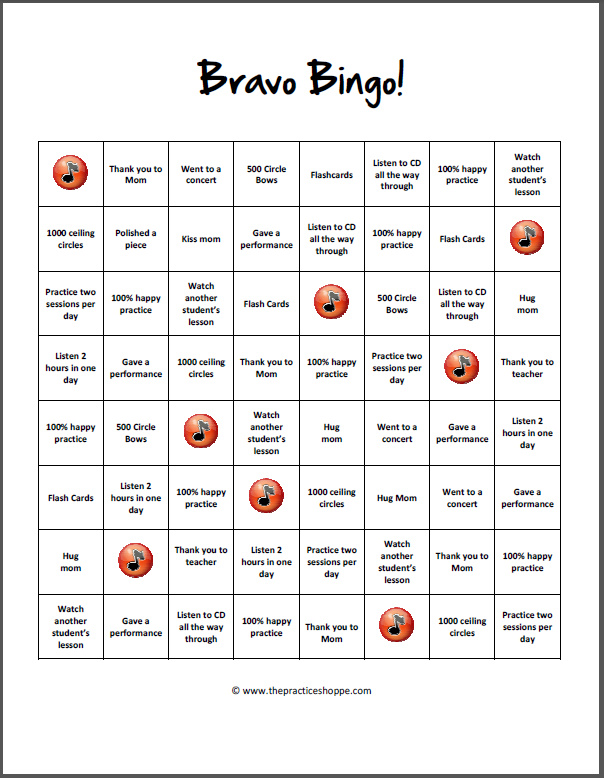
Bravo Bingo again

I made this Bravo Bingo chart a while ago and it's so cute!  I updated it from the Maurer's String Book.  However, I'm finally getting around to using it with my daughter and I can see that some things need to change.  Most of all it needs to be customizable (is that even a word?)  So, I've attached it as a Word document on the Practice Shoppe website so you can download it and put any sort of exercises you need in the different spots.  My daughter's favorite square is "Hug mom."  Probably because it's the easiest - but I like it!